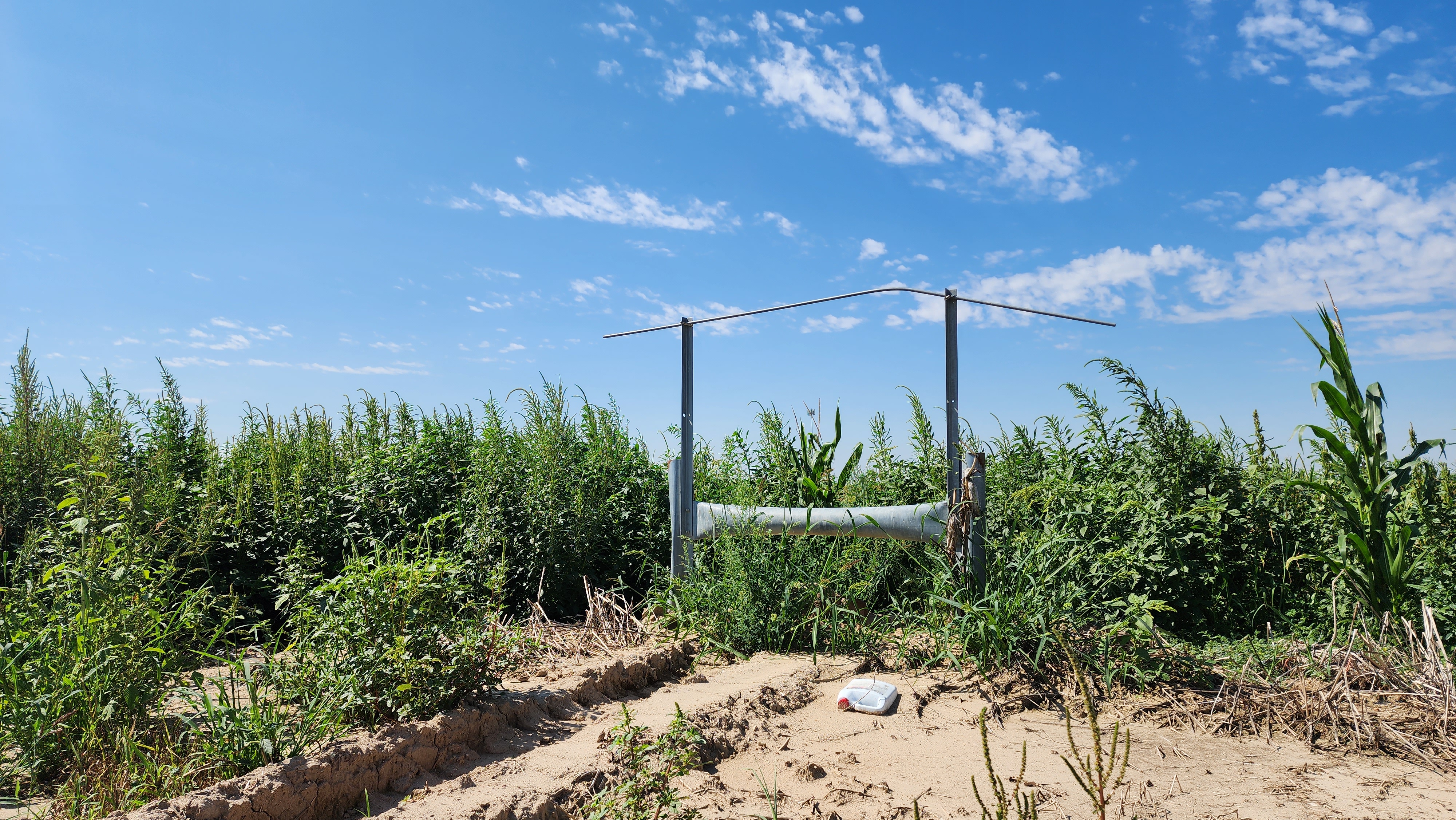

Clarke Alder, Betaseed Regional Sales Manager for the Amalgamated region, has a BS degree in Horticulture and a MS degree in weed science from Utah State University. He has spent the past 17 years studying weed science,14 of which have been directly associated with sugarbeets. In July 2025, Alder completed 13 years with Amalgamated Sugar as he joined the Betaseed team, replacing Joe Freiburger as the Sales Manager for Idaho Oregon and Washington. Clarke, his wife, Bri, and six children currently reside in Middleton, Idaho.
Alder was published with Albert Adjesiwor, Joel Felix, Olivia Landau, Andre Araujo, Todd Gaines, and Nevin Lawrence in Weed Technology, a journal out of Cambridge University Press. The article, “Palmer Amaranth (Amaranthus palmeri) in the Pacific Northwest: Glyphosate-Resistance Confirmation and Efficacy of Selected Herbicides,” is just one of several studies Alder has submitted over the past year. This study, conducted over 2023 and 2024, assessed the response of Palmer amaranth populations to selected postemergence herbicides. According to the study, “The widespread glyphosate resistance in the collected samples suggests that Palmer amaranth populations are being introduced into the PNW from locations where resistance to herbicide sites of action has previously
evolved.”
Additionally, Alder was published along with Adam Kennedy, Sushmita Sharma, and Albert Adjesiwor in the Agrosystems, Geosciences & Environment journal last year. In this article, “Relating soil herbicide residue levels to sugar beet stand and growth reduction,” Alder and his team assessed the relationship between soil residue levels of six herbicides: flumioxazin, imazamox, mesotrione, metribuzin, rimsulfuron, and terbacil over the course of 2022 and 2023. The results of the study demonstrated that laboratory analysis of herbicide residue levels in the soil must be accompanied by bioassay to determine the potential crop damage from herbicide carryover.
The Agrosystems, Geosciences & Environment journal is published on behalf of the American Society of Agronomy (ASA), Crop Science Society of America (CSSA), and the Soil Science Society of America (SSSA). The ASA, CSSA, and SSSA are committed to publishing scholarly research, reference titles, and periodicals in support of agronomy.
Alder has a third collaboration in review regarding metamitron on sugarbeets in the Western United States due to be published in Weed Technology later this year.